
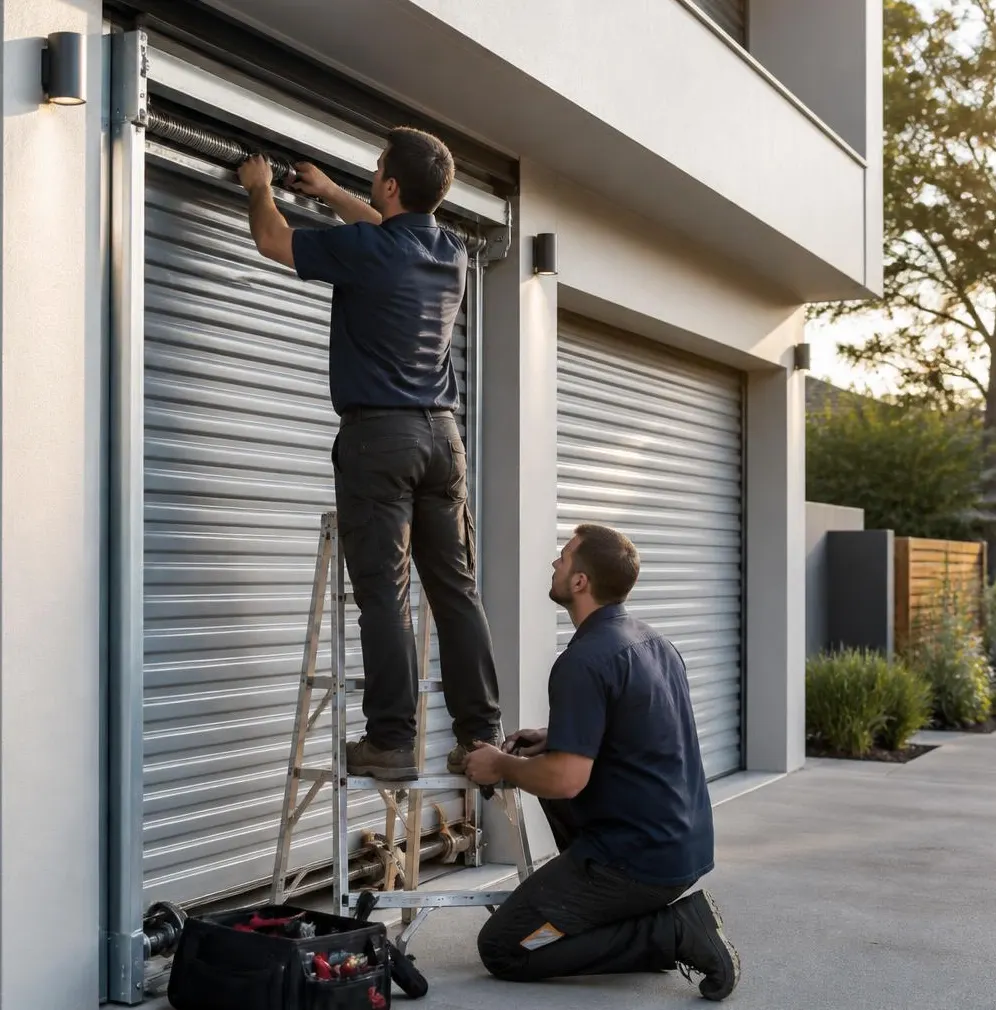
What a Technician Sees on These Calls
A typical fall service call starts the same way: a homeowner heard a bang during a windstorm, went out to the garage, and found a door panel bowed inward, a track pulled away from the wall, or rollers popped clean out of their channel. Sometimes the door still closes, but it rattles and flexes every time a gust hits it. Other times the opener has stripped a gear trying to force a door that's no longer traveling straight. Almost every one of these calls traces back to the same root cause: the door wasn't built or maintained to handle sustained wind pressure, and nobody noticed the warning signs until a storm found the weak spot.
Why the Garage Door Is a Home's Weakest Wall
Every other exterior wall on a house is a solid, continuous structure tied into the framing. A garage door is a large moving panel held in place by tracks, rollers, hinges, and a spring system doing all the structural work that a wall normally does on its own. When wind pushes against a house, that pressure has to go somewhere, and a garage door with worn rollers, a loose track, or thin, unreinforced panels is the path of least resistance. Once a door fails in a storm, wind can get inside the garage and push up on the roof structure from underneath, which is why severe weather preparedness guides consistently flag garage doors as a priority, right alongside roofs and windows.
Why This Matters Right Now in Southeast Michigan
October and November in this part of Michigan bring some of the year's strongest wind events, often tied to fast-moving storm fronts ahead of the first real cold snaps. These aren't the humid summer thunderstorms with heavy rain and lightning; they're wind-driven systems that can gust hard with little warning, sometimes with the first real cold air of the season right behind them. A door that's been fine all through a mild summer can suddenly show its weaknesses once gusts pick up and temperatures start dropping, because cold air also stiffens springs and nylon rollers, changing how the whole system behaves under load.
Inspect the Track and Roller System
Walk the full length of both tracks and look for gaps where the track has pulled away from its mounting brackets, bends, or rust starting to form from summer humidity. Rollers should spin freely and sit fully inside the track. If you see flat spots on plastic rollers, cracked nylon, or metal rollers that look pitted, those are failure points a strong gust will find first. Loose track bolts are one of the most common causes of a door that shifts or binds during high wind, and they're usually a quick tightening job if caught early.
Check Panel Condition and Reinforcement
Steel panels can dent or bow under direct wind pressure, especially on wider doors without horizontal struts across the back. If your door doesn't have reinforcing struts, or only has one, that's worth discussing before storm season gets going in earnest, since struts are what keep a panel from flexing and separating from the track under pressure. Wood doors should be checked for soft spots or swelling where moisture got in over the summer, since waterlogged wood loses rigidity right when it needs to hold firm.
Test the Auto-Reverse and Opener Response
Place a block of wood on the ground where the door closes and run it down. It should reverse immediately on contact. This matters more in fall because a door that's fighting wind pressure on the way down can behave unpredictably, and a sluggish or unreliable auto-reverse turns a minor wind problem into a safety issue. If the opener struggles, hesitates, or the door reverses without any obstruction, that's often a sign the opener is compensating for a door that's already out of balance.
Seal Gaps Before Wind-Driven Rain and Snow Arrive
Check the weatherstripping along the bottom and sides of the door. Gaps let wind-driven rain or the first wet snow push moisture into the garage, which then sits against a concrete floor that's about to start seeing road salt tracked in all winter. Replacing worn weatherstripping now is inexpensive compared to dealing with water damage or a door that freezes to the slab later in the season.
Have the Spring System Checked
Springs under tension are doing more work than people realize, and a door with a weak or miscalibrated spring won't track evenly, which means it won't seal evenly either. Wind exploits that unevenness. Spring adjustments and replacements are not a DIY project; the tension involved can cause serious injury, and this is one of the jobs best left to someone with the right bars and experience.
When to Call Washington Garage Door Experts
If your door rattles, bows, or shifts in wind, if a panel has visible storm damage, or if the auto-reverse test didn't stop the door immediately, it's time to get it looked at before the next front comes through. Our technicians handle garage door repair for tracks, rollers, and panels, and we also do spring replacement when a door is out of balance and not holding tension the way it should. We serve Washington, Shelby Township, Romeo, Ray Township, Bruce Township, Macomb Township, Rochester Hills, and Utica, and we show up ready to diagnose the actual problem rather than guess at it.
If you're searching for a garage door company near 48094 or looking for a local garage door technician in Washington, MI, get your door checked before the next windstorm rolls through. Call Washington Garage Door Experts today to schedule an inspection and head into winter with a door that's actually ready for it.